A Massachusetts Vision for Sustainable Advanced Manufacturing
By Mary Ann Stewart
The sweeping federal tax cut and spending package signed into law shreds our nation’s economic fabric. It rolls back clean energy incentives, slashes workforce grants, and stalls the momentum of regional innovation hubs supporting local manufacturing.
Massachusetts, long a beacon of ingenuity and industrial legacy, is now at a crossroads. This is an opportunity to re-imagine manufacturing and workforce development.
For decades, “manufacturing” conjured images of industrial repetition: long assembly lines, heavy machinery, and extractive systems.
Today, that image is being reshaped by a new generation of thinkers, makers, and educators who see manufacturing not simply as production, but as key to sustainability: of materials, of systems, of communities, of possibility itself.
Manufacturing That Thinks…and Learns
Modern factories can no longer rely on physical power and scale alone; they must optimize efficiency and use advanced techniques.
Technologies like ”digital twins” allow companies to simulate and refine processes before a single material is processed, like a pilot uses a flight simulator to practice before entering the cockpit. Artificial intelligence, predictive tools, and real-time analytics help manufacturers reduce waste and anticipate disruptions.
These systems aren’t just smart, they’re adaptive, and adaptive intelligence requires institutional support. Without adequate federal investment, manufacturers are left piecing together innovation with limited resources, attempting to stitch together new systems while essential funding and institutional supports fray.
The Power of Local
Supply chain disruptions and national security concerns have driven some manufacturing back to the US. This shift promised clean energy jobs, more resilient supply chains, and sustainable industries with stronger local roots. This “reshoring” movement, that the CHIPS Act and Inflation Reduction Act helped catalyze, was the result of the Covid-19 pandemic’s wake-up call that exposed fragile global supply chains, revealing just how dependent the US had become on overseas manufacturing.
Now, those promises are fading quickly.
As budget rollbacks threaten nearly 400,000 clean energy jobs created since 2022, the drive for local, sustainable manufacturing remains strong, especially in places like Massachusetts, where industrial history intersects with climate innovation and local economic renewal.
One such model? Fibershed. (https://www.fibershed.org)
Born in California from the heart and vision of Rebecca Burgess, who asked a deceptively simple question: Who, within 150 miles, could make my clothes from scratch using only natural fibers and dyes?
That inquiry grew, first into a regional network, and is now a global network (of 79 affiliates across 18 countries and counting), linking farmers, mills, dyers, and other textile artisans into supply chains that build sustainable ecosystems, economies, relationships, and communities.
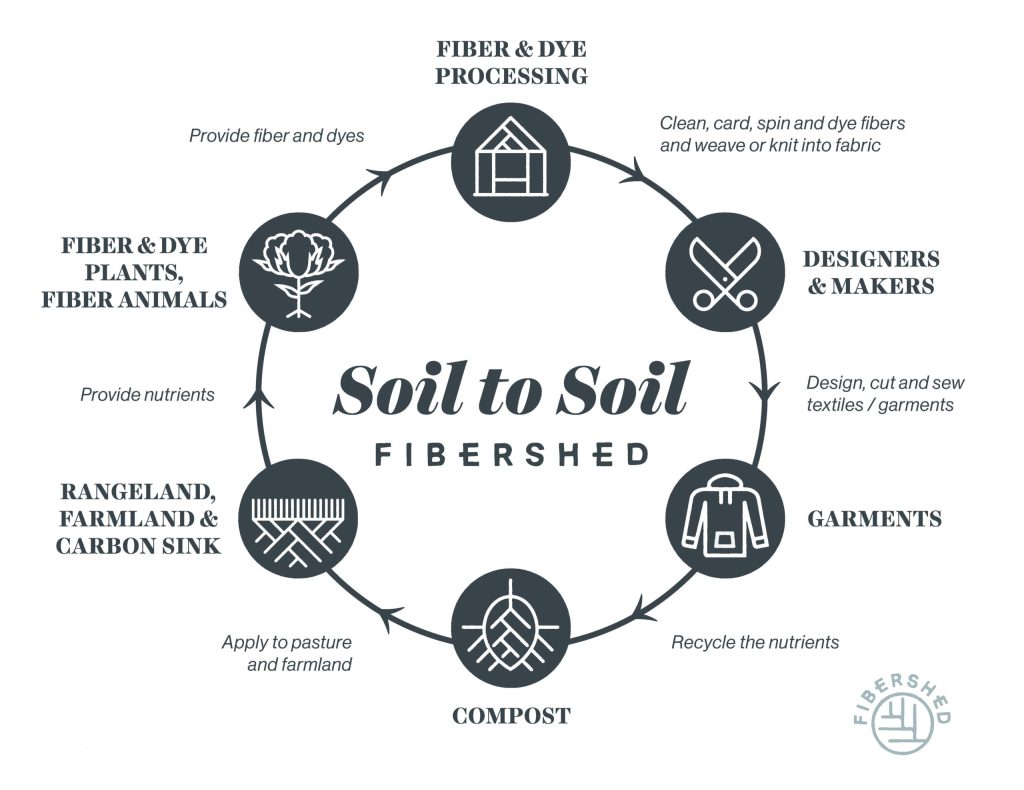
The soil-to-soil icon championed by Burgess offers Fibershed affiliates a sustainable, community-based manufacturing model and it offers all communities a blueprint for what local manufacturing could become: rooted in place, ethics, and sustainability.
And yet, even the most sustainable systems need people to steward them.
Education is Essential Infrastructure
No manufacturing system can thrive without a prepared and empowered workforce. That means equipping the next generation not just with technical skills, but with curiosity, creativity, and a systems-thinking mindset.
Enter Massachusetts’ Innovation Career Pathway (ICP) Program, an initiative empowering high school students to explore fields like advanced manufacturing, clean energy, and robotics.
At June’s Board of Elementary and Secondary Education meeting, we heard how schools like North Andover High foster more than technical skill; they’re cultivating a workforce attuned to systems- and design-thinking, community, and climate resilience.
The program opens multiple pathways to success through immersive, hands-on learning, meaningful workplace experiences, and strong industry partnerships.
Learning to solve real-world problems and engaging with ethical, inclusive projects, students uncover their strengths, connect learning to life goals, and graduate with a high school diploma, college credit, and a professional edge that makes career success individualized and attainable.
This type of interdisciplinary learning is gaining momentum: for the 2025-2026 school year over 8,500 students will participate in one or more of the 262 ICP Programs being offered by 117 high schools across the state.
That’s promising, but not enough.
Vital programs like ICP need nurturing and, with federal grants disappearing, sustaining these innovations will depend on bold leadership and collaborative infrastructure driven by the state.
High-quality ICP Programs depend on empowered teachers who are the architects of these complex learning experiences. They need to be able to weave together multiple disciplines, build partnerships with local employers, and adapt learning to student needs. This raises important questions:
- Are we investing in their professional growth, creativity, and agency?
- Is the state supporting educator leadership and capacity-building to ensure high-quality delivery of these interdisciplinary, project-based learning pathways?
Voice in the Workforce Development Ecosystem
Too often workforce pipelines are built around employers’ needs, not learners’ full capacities. Educator development, expanded partnerships, and programs that are co-created with students and families, especially in Gateway Cities and historically underserved regions, must be supported and funded.
From Extraction to Sustainability
The stakes are high. Manufacturing is becoming greener, but progress is slow and the future is precarious. Clean facilities, circular design, and climate-conscious engineering are no longer optional, they’re the inevitable future.
And yet, under the new federal budget bill, many of these initiatives face funding cuts. We must resist this regression. The shifting of the frame from production to stewardship. from output to holistic impact, and from extraction to sustainability must be supported.
That means investing not only in technology, but in people, pedagogy, communities, and innovation.
Advanced manufacturing should reflect our values: efficiency tempered with ethics, automation balanced by artistry, and profit guided by planetary care. We need to build systems that don’t just produce, but sustain.
What Comes Next
Massachusetts has the talent. It has the legacy. And it has the leadership to model a new industrial era: one where students are co-creators and where innovation enhances justice.
This isn’t simply a moment of reckoning.
It’s a moment to mend; a moment to rethink manufacturing as a circle, not a line; a moment to thread climate action through every sector, not just clean energy. It’s an opportunity to empower educators and amplify Student Voice as we design what comes next.
Manufacturing must be more than efficient; it must be ethical, local, and ecological.
We need to build the future with intention, not just repair what’s broken. We need to build what sustains us all.
___
Mary Ann Stewart is a member of the Massachusetts Board of Elementary and Secondary Education, a member of Southeastern New England Fibershed, and an advocate for regenerative systems and champion of creative repair in education, leadership, and manufacturing.
 Mary Ann Stewart